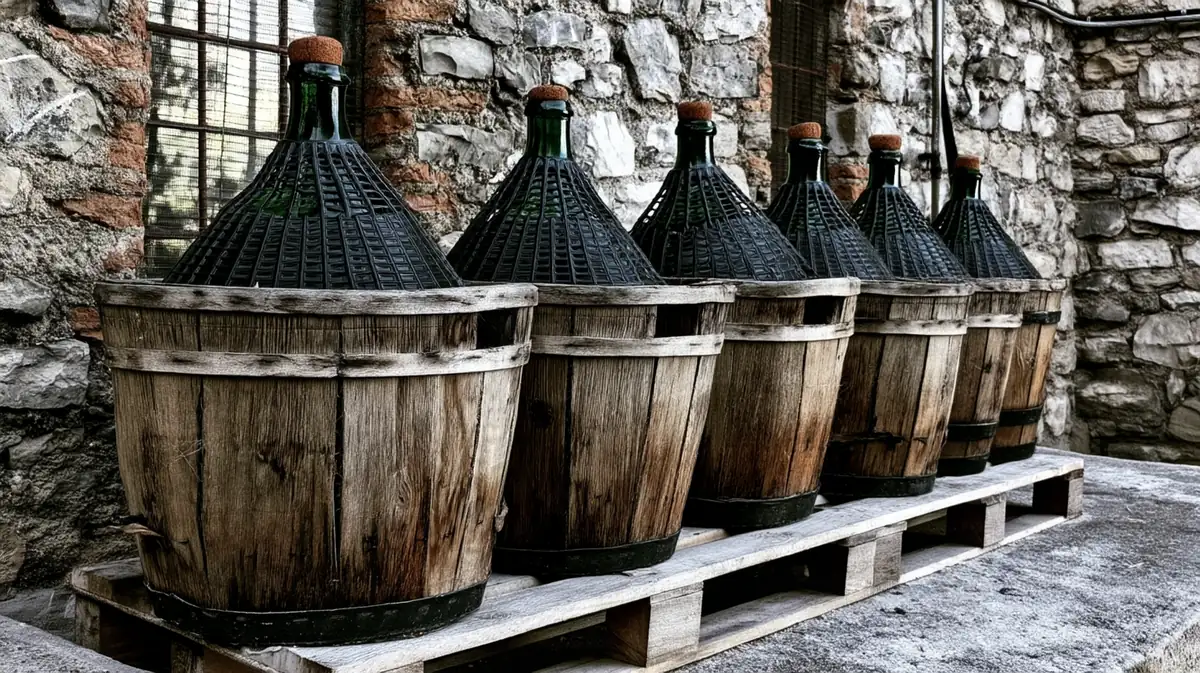
A demijohn is the simplest and cheapest way to take bulk wine home. But between the winery and your glass there are four moments when wine can be spoiled: choosing the size, cleaning, filling and transport. Here is what to do at each step, based on what oenology says, not hearsay.
Which size to choose
The most common demijohns range from 5 to 54 litres. Here is how many 0.75-litre bottles they fill and how much the wine inside weighs (wine weighs about 1 kg per litre, plus the glass):
| Demijohn | 0.75 L bottles | Weight of the wine alone |
|---|---|---|
| 5 litres | 6 | about 5 kg |
| 10 litres | 13 | about 10 kg |
| 15 litres | 20 | about 15 kg |
| 20 litres | 26 | about 20 kg |
| 25 litres | 33 | about 25 kg |
| 34 litres | 45 | about 34 kg |
| 54 litres | 72 | about 54 kg |
The rule for choosing: pick the size you can finish, or bottle, within 2–3 weeks of starting to draw from it. Every litre you take out leaves room for air, and a half-empty demijohn spoils quickly (we explain why in the guide on how long bulk wine keeps). If you drink little wine each week, two 15-litre demijohns are better than one 34-litre one: you open one at a time and the other stays full.
Think about the weight too: a full 54-litre demijohn is over 55 kg. You need someone to help, and a place where you won’t have to move it again.
Clear or coloured glass?
Glass is the best material for wine: it releases nothing and does not let oxygen through. Colour matters because of light: green or brown glass protects better against light, which in whites and rosés can cause “light-struck taste”, a smell of cooked cabbage. If your demijohn is clear glass, no problem: keep it in the dark. The basket or plastic cover protects it from knocks and partly from light.
How to clean the demijohn (before every filling)
Cleaning has two separate steps: first you clean (remove the dirt), then you sanitise (kill yeasts and bacteria). Sanitising a dirty demijohn is pointless.
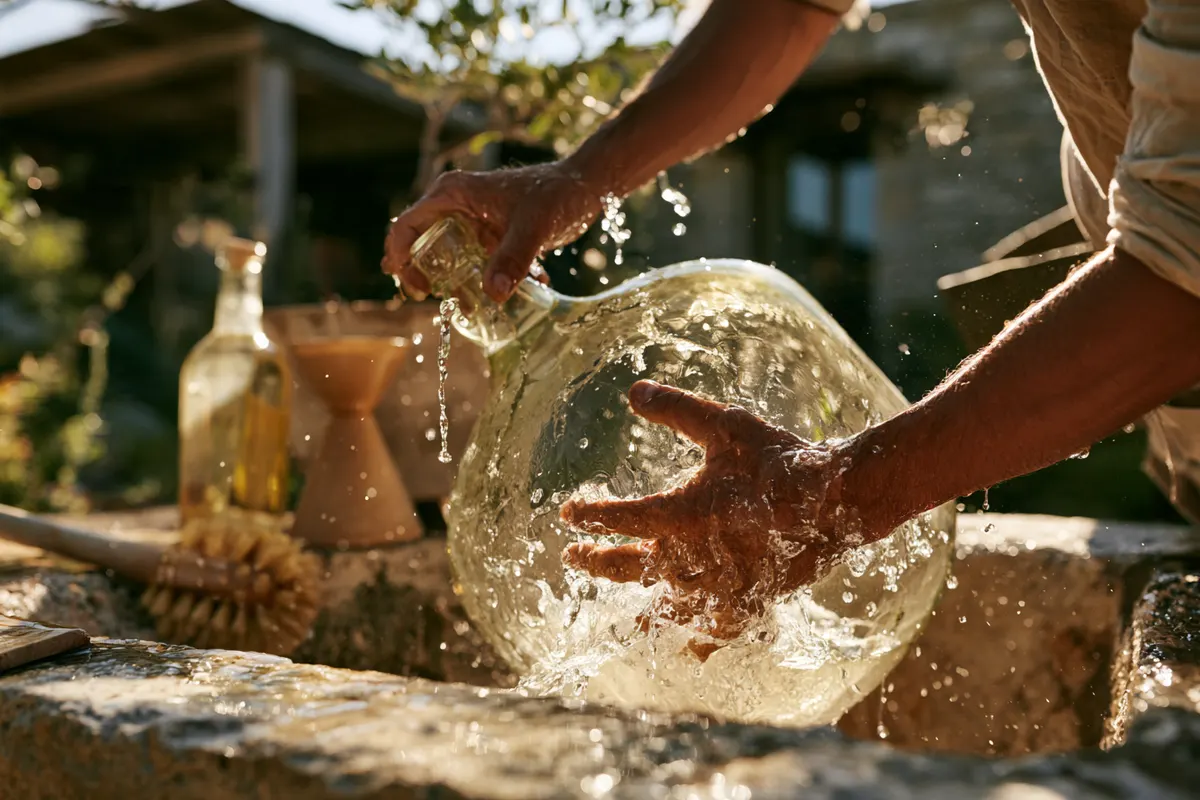
1. Clean. Hot water and a bottle brush, until the walls are clear and there is no smell left. For stubborn residues, such as wine stains or a film of dirt, use sodium percarbonate, also sold in winemaking shops: it cleans light dirt well and rinses off easily. Then rinse with plenty of water.
Do not use bleach or scented detergents. Chlorine, in contact with wood, stoppers or residues, can lead to haloanisoles, the same substances behind “corked” and mouldy smells. Tiny traces are enough to ruin wine: that is why chlorine is not recommended in wineries.
2. Sanitise. Make an acidulated sulphur dioxide solution, the one wineries use:
- 10 litres of cold water
- 2 grams of potassium metabisulphite
- 30 grams of citric acid
Pour a few litres into the demijohn, close it, shake well so that it wets all the walls and the neck, then empty it. The citric acid makes the sulphur dioxide more effective. Caution: the solution releases a pungent gas. Make it outdoors or in a well-ventilated room, do not breathe it in closely and keep it away from anyone with asthma.
After use: empty the demijohn, rinse it straight away and let it dry upside down. A demijohn left with some wine at the bottom becomes a breeding ground for mould and vinegar bacteria.
How to fill it: air is the enemy
The most important point: fill it up to the neck. The empty space between wine and stopper, the headspace, is full of air. Oxygen oxidises the wine and lets film yeasts and vinegar bacteria grow, and they cannot live without oxygen.
- Fill to a few centimetres below the stopper
- Use a stopper that seals well, cleaned and sanitised like the demijohn
- Don’t leave it open: close it as soon as it is full
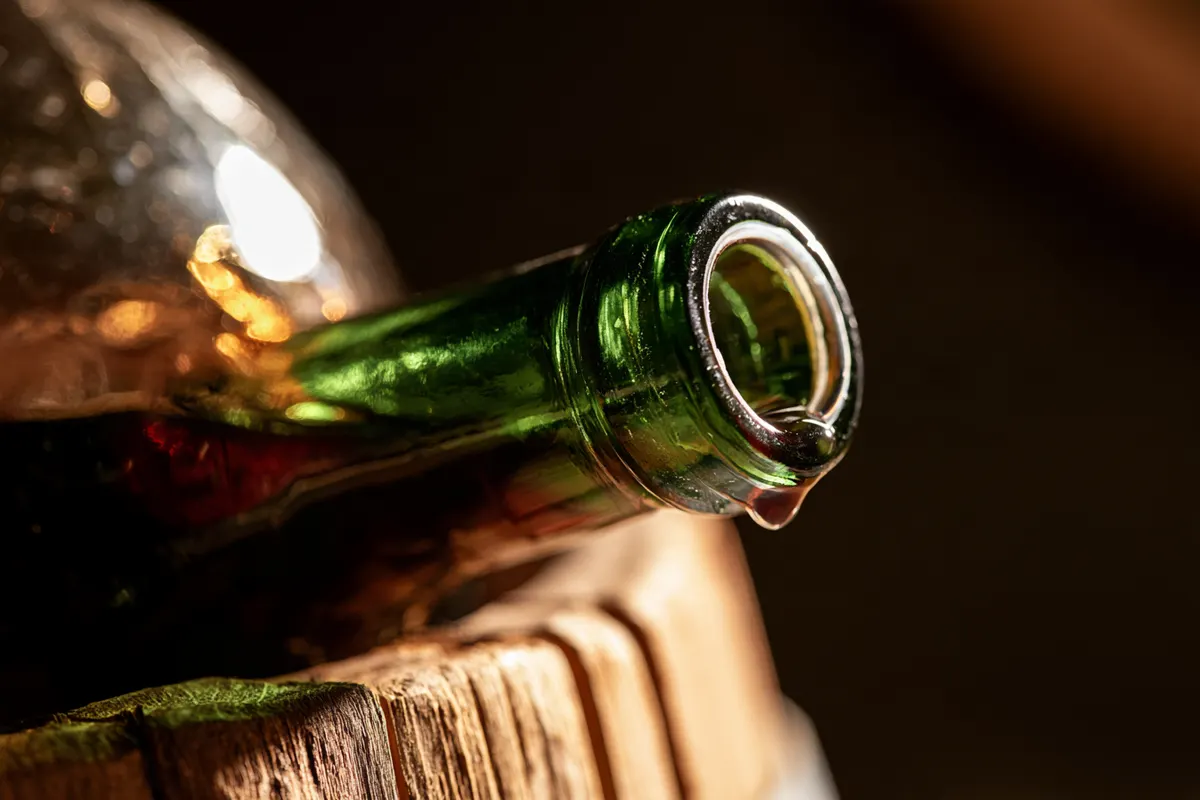
And later, when you start drawing wine? The empty space grows with every draw. There are three solutions: move the wine into smaller containers you can fill, bottle it (a 54-litre demijohn makes 72 bottles), or fill the empty space with an inert gas. Argon cans for wine are sold in winemaking shops. Argon is heavier than air, so it settles on the wine and covers it. The OIV Code of Oenological Practices provides for the use of inert gases (argon, nitrogen, carbon dioxide) to protect wine from air.
Transport: beware of the car in the sun
The riskiest moment is the journey. A study published in the scientific journal Temperature measured the cabin air of six cars parked in summer in Arizona: after one hour in the sun the cabin averaged 46°C, in the shade about 38°C. Heat speeds up all the reactions that age wine: in a study by the Fondazione Edmund Mach, red wine stored at home, in the warm, aged about 4 times faster than wine in a cellar.
What to do:
- Go straight home after loading the wine. If you need to stop, park in the shade and don’t leave the demijohn in the car for hours.
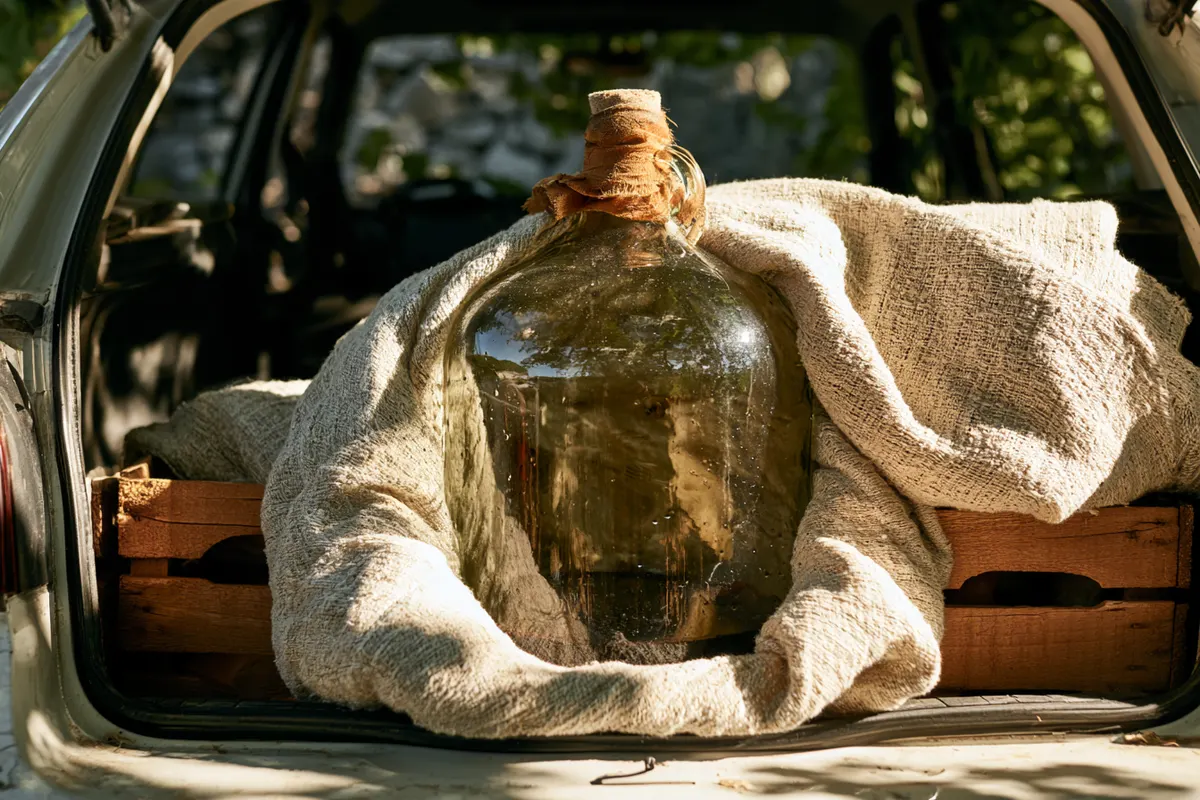
- Keep it upright and still: wedge it with crates or a blanket so it doesn’t knock or tip over.
- Shield it from the sun with a blanket, even in the boot.
- As soon as you arrive, put it somewhere cool and dark: a cellar, a north-facing garage, an underground room. The ideal storage temperature is 10–15°C, as steady as possible.
Where to keep it and how long it lasts
A full glass demijohn, well sealed, kept cool and dark, keeps wine for up to 6 months, if the wine is already stable and protected with the right dose of sulphites. If you don’t know whether yours is, ask us when you buy it. Timings case by case, and how to tell if wine has gone off, are in the guide on how long bulk wine keeps.
If you plan to bottle it, the best dates are in the 2027 lunar calendar for bottling. If you need it for a party, see how much wine you need for your guests.
At our winery in Roncadelle di Ormelle, bulk wine goes from the cellar, where it is kept at 12–14°C, straight into your demijohn. Bring it clean and we fill it for you, right up to the neck.
Sources
- OIV, International Code of Oenological Practices: protection of wine with inert gases (nitrogen, argon, carbon dioxide)
- Zoecklein B. W., Winery Sanitation, Virginia Tech, Enology-Grape Chemistry Group: acidulated SO₂ solution (200 mg/L metabisulphite and 3 g/L citric acid), percarbonate, chlorine not recommended because of the risk of haloanisoles
- Ribéreau-Gayon P. et al., Handbook of Enology, vol. 2 (Wiley): oxidation, sulphur dioxide, acetic bacteria
- Vanos J. K., Middel A., Poletti M. N., Selover N. J. (2018), “Evaluating the impact of solar radiation on pediatric heat balance within enclosed, hot vehicles”, Temperature 5(3): 276–292
- Arapitsas P., Mattivi F. et al. (2014), “The influence of storage on the ‘chemical age’ of red wines”, Metabolomics 10(5), Fondazione Edmund Mach
- Fracassetti D. et al. (2021), “Light-struck taste in white wine: Reaction mechanisms, preventive strategies and future perspectives to preserve wine quality”, Trends in Food Science & Technology 112: 547–558, University of Milan